
Description
Copper ore is a naturally occurring mineral deposit that contains copper in sufficient concentration to make its extraction economically viable. It is one of the most important industrial minerals, widely used in electrical, construction, and manufacturing industries due to its excellent electrical and thermal conductivity, malleability, and corrosion resistance.
The most common copper-bearing minerals include chalcopyrite (CuFeS₂), bornite (Cu₅FeS₄), malachite (Cu₂CO₃(OH)₂), azurite (Cu₃(CO₃)₂(OH)₂), and cuprite (Cu₂O). These ores typically occur in igneous, metamorphic, and sedimentary rocks, often associated with other metallic minerals such as gold, silver, lead, and zinc.
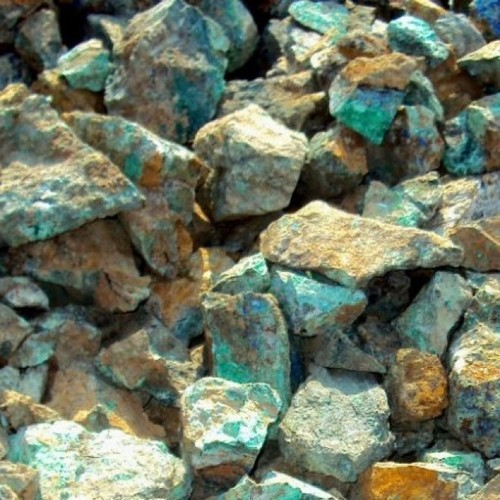
Copper ore typically contains 1% to 5% copper content, though high-grade ores can contain up to 10% or more. The color of copper ore varies depending on its composition—from green and blue hues (in oxidized ores) to metallic yellow or reddish-brown tones (in sulfide ores).
After mining, copper ore undergoes crushing, grinding, concentration (usually by flotation), smelting, and refining to produce pure copper metal. The final product is used extensively in electrical wiring, electronics, plumbing, roofing, alloy production (such as brass and bronze), and renewable energy systems.
Key Characteristics:
Chemical Composition: Varies by mineral type (CuFeS₂, Cu₂CO₃(OH)₂, etc.)
Copper Content: 1–10% (average commercial grade)
Color: Green, blue, reddish-brown, or metallic yellow
Density: 2.8–4.5 g/cm³
Industrial Uses: Electrical conductors, electronics, construction, machinery, and alloys.
Reviews
There are no reviews yet.