
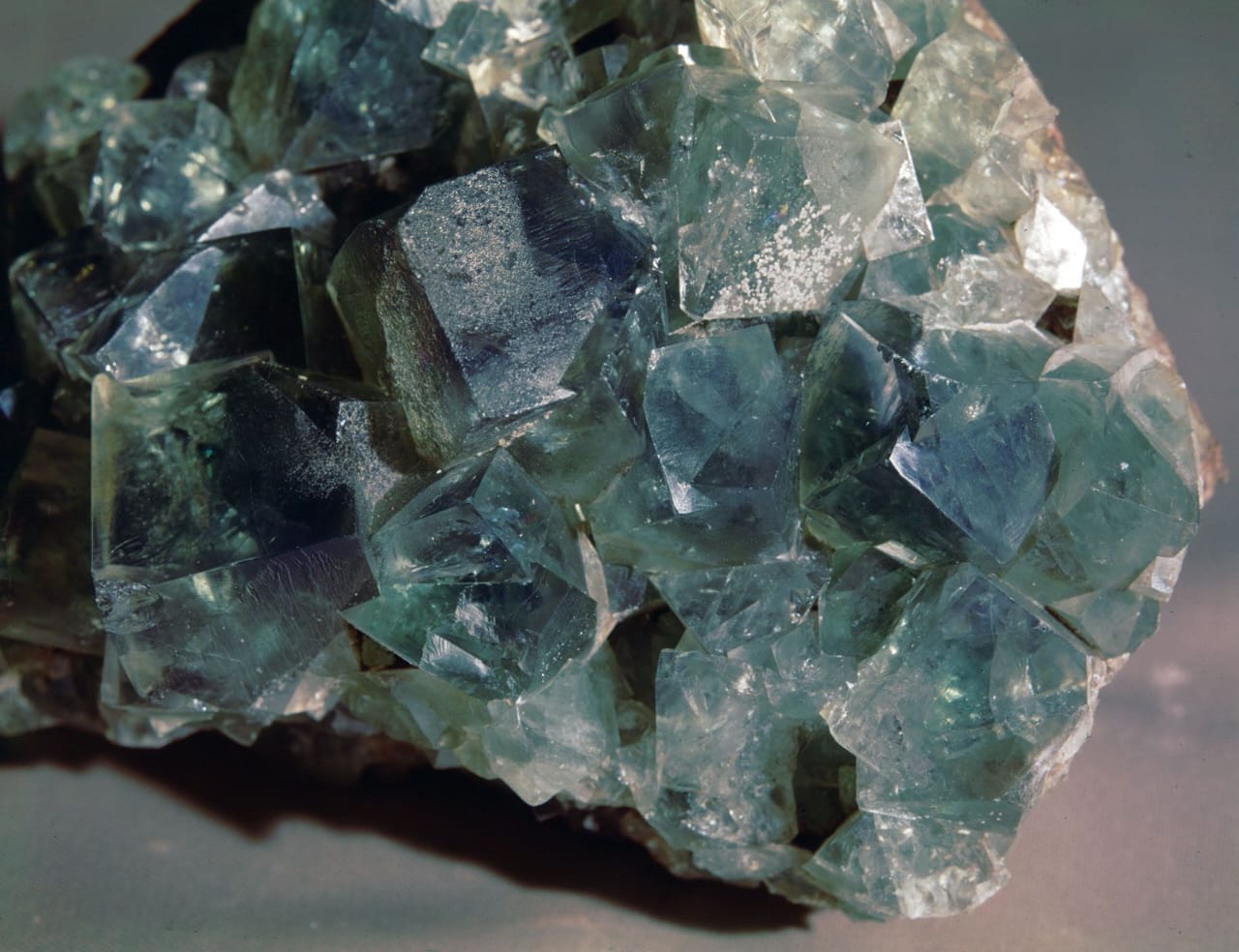
Description
Fluorite, also known as fluorspar, is a naturally occurring mineral composed primarily of calcium fluoride (CaF₂). It is renowned for its vibrant colors, which range from colorless to shades of purple, blue, green, yellow, and pink, depending on impurities and trace elements present in the crystal structure.
Fluorite typically forms in hydrothermal veins, often associated with minerals such as quartz, calcite, galena, sphalerite, and barite. It occurs in both massive and well-formed cubic crystal structures, making it valuable for both industrial and decorative purposes.
Industrial Applications:
Metallurgical Use: As a flux in steelmaking and aluminum production to reduce slag viscosity and remove impurities.
Chemical Industry: A major source of hydrofluoric acid (HF), which is used in producing refrigerants, plastics (like Teflon), and various fluorine-based chemicals.
Ceramic and Glass Industry: Added to glazes and enamels to improve surface finish and appearance.
Optical Use: High-grade transparent fluorite is used in lenses and prisms due to its low dispersion and clarity.
Physical Properties:
Chemical Formula: CaF₂
Hardness: 4 on Mohs scale
Specific Gravity: 3.0 – 3.2
Crystal System: Isometric (Cubic)
Luster: Vitreous
Cleavage: Perfect octahedral
Economic Importance:
Fluorite is a strategic industrial mineral essential in metallurgical, chemical, and optical applications. Major deposits are found in China, Mexico, South Africa, Mongolia, and Spain, with varying grades categorized as metallurgical, ceramic, and acid-grade fluorite based on purity.
Reviews
There are no reviews yet.